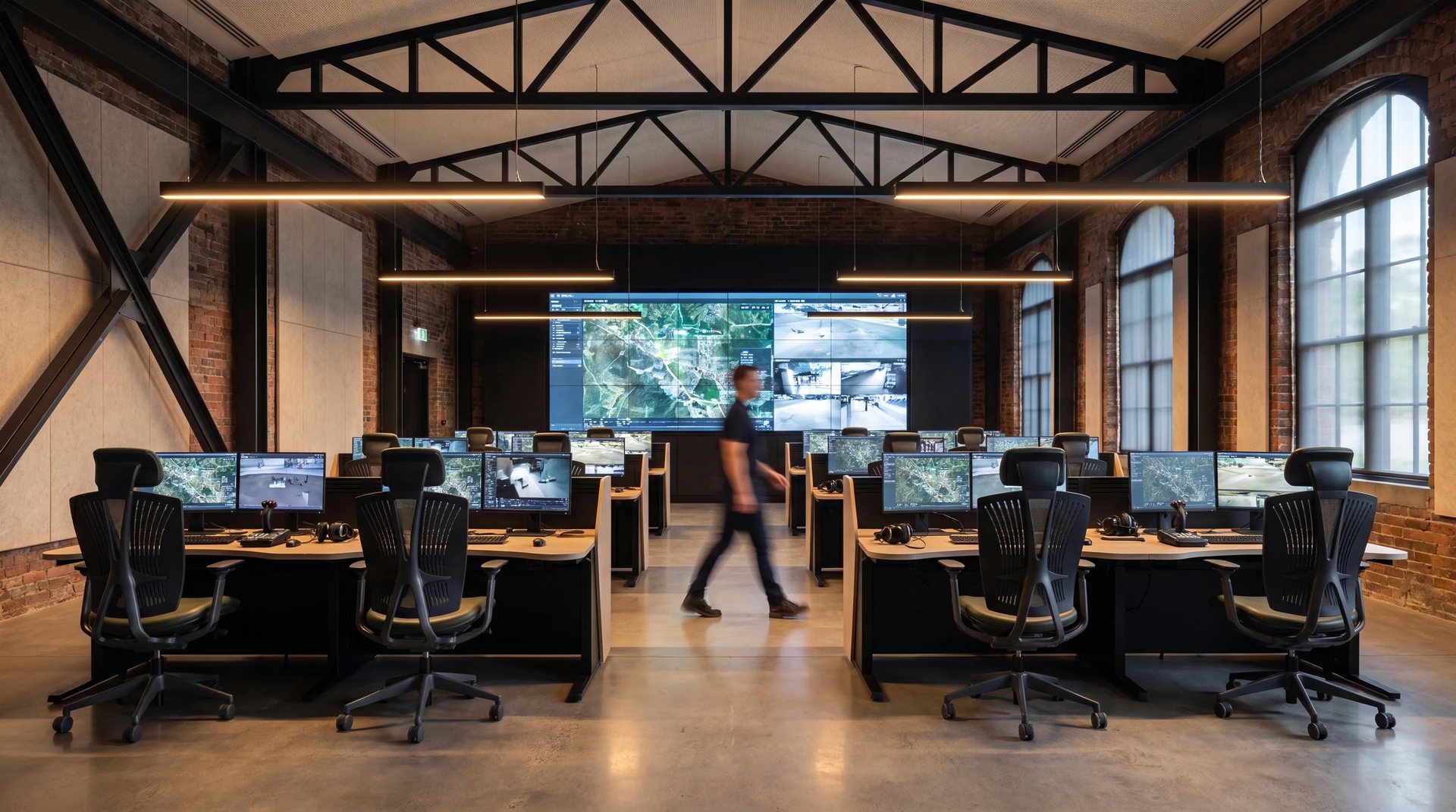
Nightingale has built commercial seating in Toronto since 1928. The chairs earn their place in some of the most demanding workplaces in North America. The website that sold them did not. Over ten months we rebuilt the entire digital side of the business, from the brand down to the pricing engine, so the experience finally matched the product.
This is not a story about a redesign. A new coat of paint on a broken configurator still leaves you with a broken configurator. It is a story about treating a manufacturer's website as the system that carries product knowledge to buyers, and rebuilding that system end to end.
Where Nightingale was losing business
Buyers judge a manufacturer by its website before a rep ever picks up the phone. Nightingale's told the wrong story. The 2D configurator loaded broken images. Textile swatches did not work. There were no prices anywhere. Search could not find products that were sitting in the catalog. The rep locator map was broken, and the footer form threw an error on every page.
Underneath all of it, the real problem: product knowledge lived in paper catalogs, spec cards, and PDFs. Nothing a buyer, a rep, or a search engine could actually use. The company was judged by its website, and the website was costing it business.
| What buyers hit | What it looked like | What it signaled |
|---|---|---|
| Broken 2D configurator | Missing images, dead swatches | The product data does not exist in a usable form |
| No pricing, anywhere | Blank where a price should be | You have to call to find out if you can afford it |
| Search that found nothing | Real products, zero results | Even the maker cannot find its own catalog |
| Errors on core forms | Footer form failed site-wide | Nobody is minding the store |
What buyers saw, 2025
A manufacturer's website is not a brochure. It is the front end of a product database. If the data underneath is broken, no amount of design will fix what the buyer feels.
Rebuilding the foundation: brand and platform
We started with a new brand identity and design system, built from scratch, then a fully custom Shopify build with more than 100 purpose-built sections and components. Pricing is market-aware in both CAD and USD. Lifestyle imagery is shoppable, so the room a buyer is looking at is also the products they can spec.
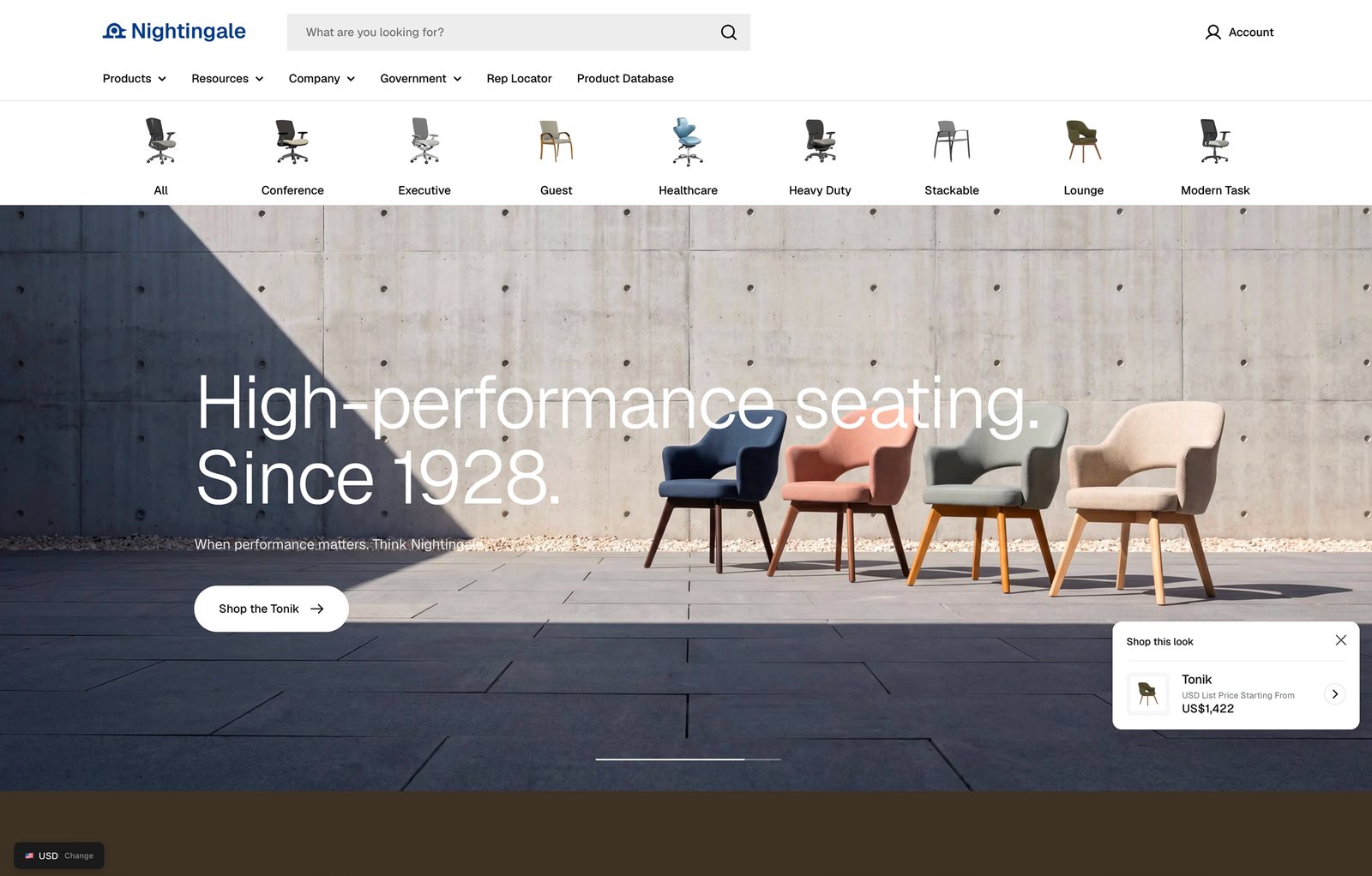
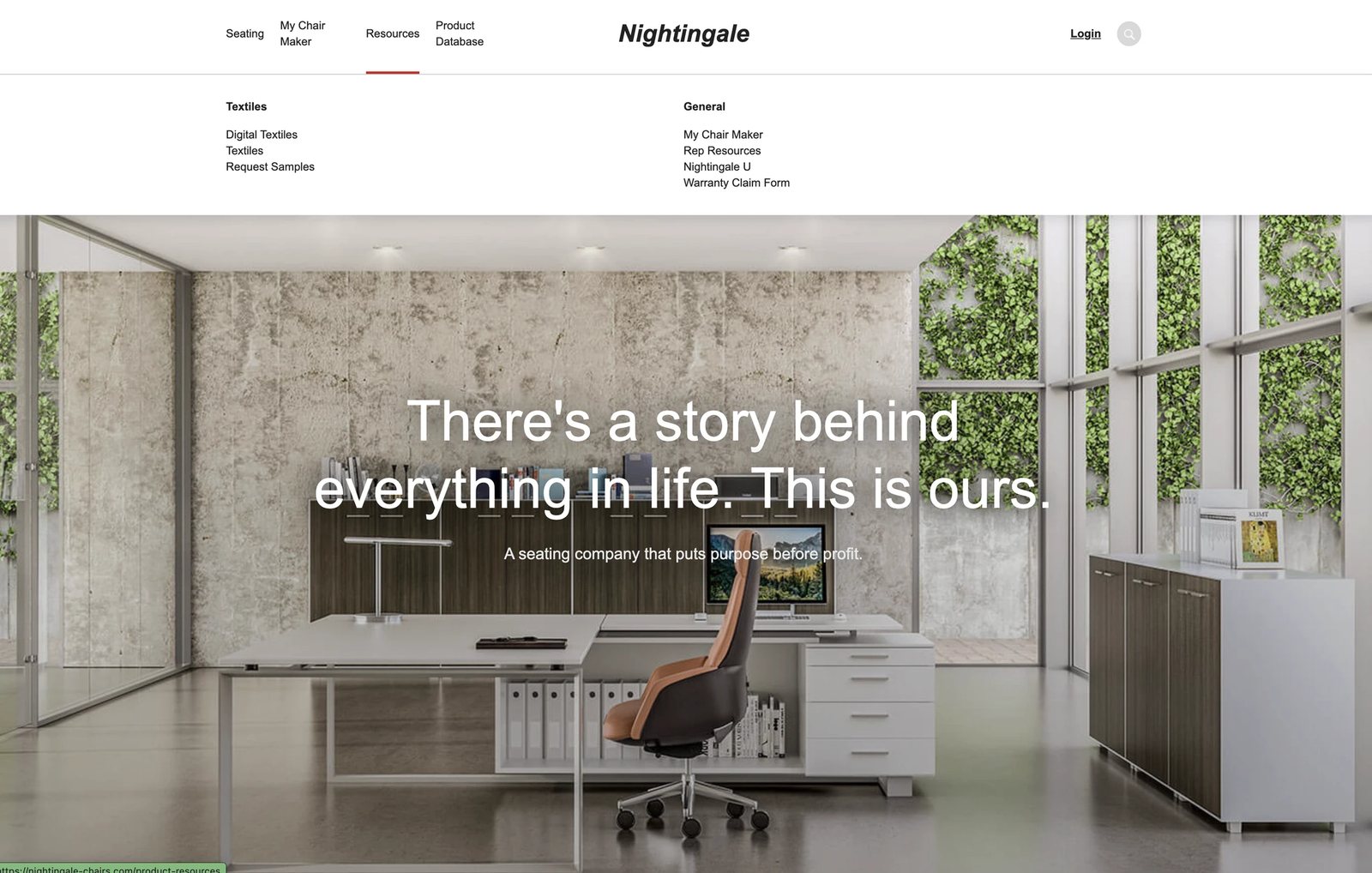 BeforeAfter
The platform was designed around how commercial seating is actually bought, in grades, options, and finishes, not how a generic e-commerce theme assumes products work. That decision shaped everything downstream.
The product data problem nobody sees
Everything a buyer trusts on the new site sits on top of a structured Postgres database we built and populated: roughly 10,000 rows across 11 tables. Chair specifications, pricing grades, and configurator options became real, queryable data instead of PDF pages.
Automated scrapers and enrichment pipelines keep that data current instead of letting it rot the way a spreadsheet would. It is the layer everything below sits on: the textile library, the configurator, and the pricing engine all read from the same tables.
The textile library
We took textiles from a wall of unlabeled thumbnails to a filterable library: every fabric with its grade, collection, content, and certifications, and every swatch opening into a full spec drawer. We built the Digital Textiles program alongside it, with digital sample books and COM support with partner mills. What used to be a dead end is now a selling tool.
The 3D configurator
Every chair in the catalog was rebuilt as a fully configurable 3D product. Buyers pick model, back, seat, arms, casters, textile, headrest, and finish, spin the chair through 360 degrees, drop it into their own room in AR, and watch the price recalculate live in USD or CAD before adding the exact configuration to a quote.
Underneath that experience sits a product data model of 12+ option sets per chair driven by dozens of visibility rules (hide the mesh color picker when upholstery is chosen, restrict backrest options by model tier, and so on), a pricing engine resolving over 8,000 market cost and list price codes across two currencies, and a Mimeeq to Shopify sync that keeps every variant priced correctly on the storefront in real time.
The result: any buyer, dealer, or rep can configure a chair to exact spec, see what it will cost in their market, and hand the same configuration to the factory as a build-ready quote.
Search was rebuilt to match: SKU-aware, predictive, with an interactive builder interface and live analytics so Nightingale can see what buyers are actually looking for. The product finally answers questions instead of raising them.
Nightingale Studio: AI imaging built for furniture
Lifestyle photography is expensive and slow, and a catalog this deep would never be fully shot. So we built Nightingale Studio, the first AI imaging platform built anywhere in the commercial furniture industry. It generates lifestyle photography on demand on AWS serverless infrastructure, with a dual-judge evaluation using Claude Vision and Gemini to hold quality, and lead capture built in.
More than 1,200 lifestyle images generated to date, each one a room a buyer can shop, none of them waiting on a photo shoot.
What changed
Nightingale now has a brand system, a commerce platform, a product-data infrastructure, product tools, and an AI platform that no competitor in its category has. The website stopped being the weakest thing about the company and became one of its strongest.
That is what a Breener engagement is. Not a template, not a subscription. A unique build the client owns, aimed at the two things that matter: selling more furniture, and making it easy for buyers to choose you. Nightingale is one example. Yours would be built for how you actually sell.